
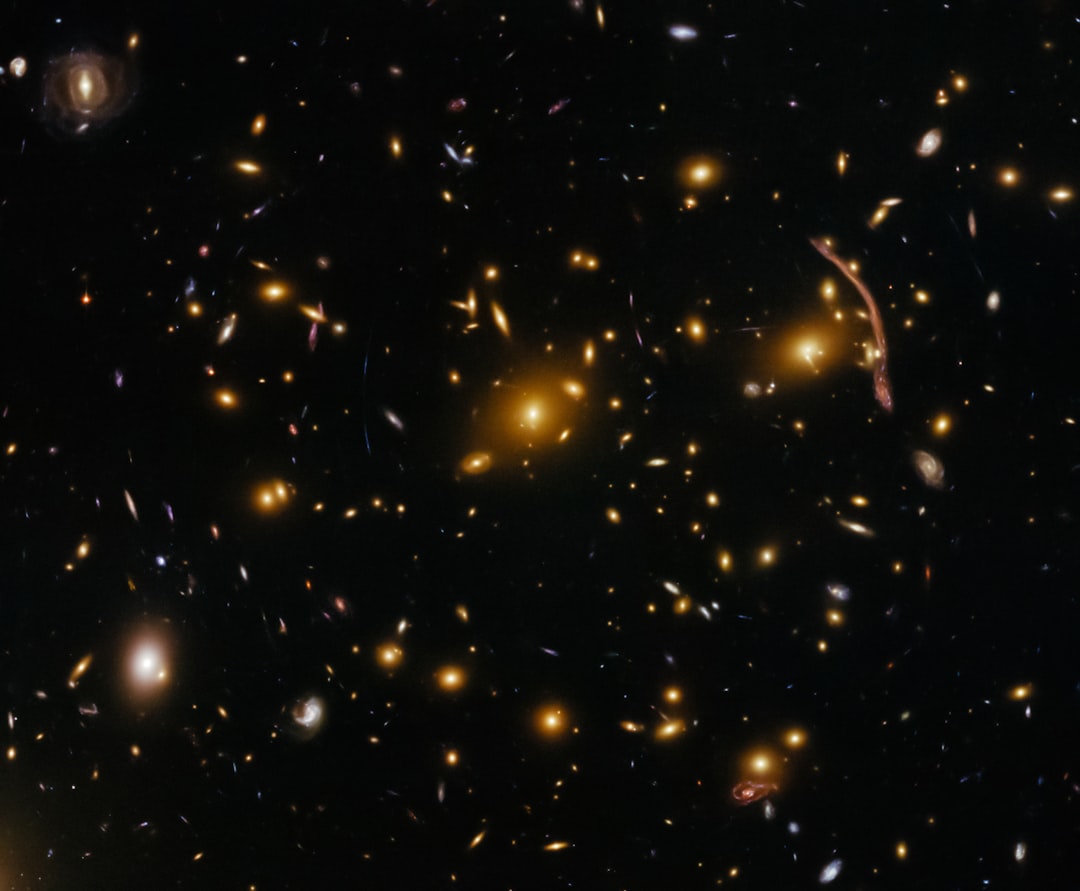
Look up at the night sky and you see stars, planets, nebulae, and galaxies. Everything visible, everything that emits or reflects light, every atom of ordinary matter in the entire observable universe accounts for just 5% of what actually exists. The remaining 95% is composed of two mysterious substances that scientists have named dark matter and dark energy. Despite decades of research involving thousands of physicists, billions of dollars in experimental infrastructure, and some of the most sophisticated instruments ever built, no one knows what either of these substances actually is.
This is not a fringe hypothesis or speculative theory. The existence of dark matter and dark energy is supported by multiple independent lines of observational evidence and is accepted by the overwhelming consensus of the physics community. Their discovery represents one of the most profound revelations in the history of science: the universe is almost entirely made of something we cannot see, cannot touch, and do not understand. When dark matter and dark energy are explained to the general public, the strangeness of our situation becomes apparent, as we inhabit a cosmos whose dominant components remain fundamentally unknown.
This article provides a comprehensive examination of what scientists currently know about dark matter and dark energy, the evidence that compels their acceptance, the experiments designed to detect them, and the theoretical frameworks competing to explain them.
The Discovery of Dark Matter: A Problem of Missing Mass
The first hints that something was wrong with our understanding of cosmic mass came in the 1930s, when Swiss astronomer Fritz Zwicky studied the Coma Cluster, a collection of more than 1,000 galaxies located approximately 320 million light-years from Earth. By measuring the velocities of individual galaxies within the cluster and applying the virial theorem from classical mechanics, Zwicky calculated the total mass necessary to gravitationally bind the cluster together. The result was shocking: the cluster required approximately 400 times more mass than could be accounted for by the visible galaxies alone. Zwicky coined the term « dunkle Materie » (dark matter) to describe this missing mass.
For decades, Zwicky’s findings were largely ignored by the scientific mainstream. It was not until the 1970s, when American astronomer Vera Rubin conducted detailed measurements of galactic rotation curves, that the dark matter problem became impossible to dismiss. Rubin and her colleague Kent Ford measured the orbital velocities of stars at various distances from the centers of spiral galaxies. According to Newtonian gravity, stars at the outer edges of galaxies should orbit more slowly than those closer to the center, just as the outer planets in our solar system orbit more slowly than the inner ones. Instead, Rubin found that orbital velocities remained roughly constant at all distances from the galactic center, a phenomenon now known as « flat rotation curves. »
This observation implied that galaxies are embedded in enormous halos of invisible matter that extend far beyond the visible disk of stars. The total mass of these dark matter halos is estimated to be five to ten times greater than the mass of visible matter in a typical galaxy. Rubin’s work, initially met with skepticism, has been confirmed by hundreds of subsequent studies and is now considered one of the foundational observations in modern astrophysics.
Evidence for Dark Matter: Multiple Independent Lines
What makes the dark matter hypothesis so robust is that it is supported not by a single observation but by multiple independent lines of evidence that all point to the same conclusion. Each line of evidence involves different physical processes, different distance scales, and different observational techniques, making it extremely unlikely that a single systematic error could explain them all.
Gravitational lensing provides perhaps the most visually striking evidence. According to Einstein’s general theory of relativity, mass curves spacetime, and light follows the curvature of spacetime. When light from a distant galaxy passes through a region of space containing a large mass concentration, its path is bent, producing distorted, magnified, or multiple images of the background galaxy. By analyzing these gravitational lensing effects, astronomers can map the total mass distribution in the foreground, including mass that does not emit light. These maps consistently show mass concentrations that far exceed the visible matter, with the excess mass distributed in patterns consistent with dark matter halos.
The Bullet Cluster, a system of two galaxy clusters that collided approximately 150 million years ago, provides what many physicists consider the single most compelling piece of evidence for dark matter. During the collision, the ordinary matter in the two clusters (mostly hot gas) interacted electromagnetically, slowed down, and remained concentrated at the center of the collision. However, gravitational lensing maps show that the majority of the mass in each cluster passed straight through the collision without interacting, exactly as dark matter, which interacts gravitationally but not electromagnetically, would be expected to behave. Research published in Nature Astronomy has confirmed these observations with unprecedented precision.
The cosmic microwave background (CMB), the afterglow of the Big Bang, provides another crucial line of evidence. The CMB contains tiny temperature fluctuations that encode information about the composition of the universe approximately 380,000 years after the Big Bang. Detailed analysis of these fluctuations by the Planck satellite mission has determined that the universe consists of approximately 5% ordinary (baryonic) matter, 27% dark matter, and 68% dark energy. These figures are consistent with independent measurements from galaxy surveys, supernova observations, and baryon acoustic oscillation studies.
What Dark Matter Is Not: Ruling Out Candidates
Decades of research have progressively narrowed the range of possible dark matter candidates. Perhaps the most important negative result is that dark matter cannot be composed of ordinary (baryonic) matter in any form. Proposals that dark matter might consist of faint stars, brown dwarfs, black holes, or other dim but conventional objects (collectively called MACHOs, or Massive Astrophysical Compact Halo Objects) have been tested through microlensing surveys and found to be insufficient to account for the observed dark matter density.
Big Bang nucleosynthesis, the process by which the lightest elements were formed in the first minutes after the Big Bang, provides a particularly powerful constraint. The abundances of hydrogen, helium, deuterium, and lithium observed in the universe match theoretical predictions only if the total amount of baryonic matter is approximately 5% of the cosmic energy density. Since dark matter comprises 27%, it cannot be baryonic in nature.
Neutrinos, which are known to have mass and interact only weakly with ordinary matter, were once considered a dark matter candidate. However, neutrinos are too light and move too fast (« hot dark matter ») to have clumped together gravitationally in the patterns observed in the large-scale structure of the universe. Cosmological simulations demonstrate that the observed cosmic web of galaxy clusters and filaments can only form if dark matter is « cold, » meaning it consists of relatively massive, slow-moving particles.
The Leading Candidates: WIMPs, Axions, and Beyond
The two most prominent dark matter candidates in current research are Weakly Interacting Massive Particles (WIMPs) and axions, though a growing list of alternative proposals is receiving serious attention.
WIMPs are hypothetical particles with masses in the range of 10 to 1,000 times the proton mass that interact with ordinary matter only through gravity and the weak nuclear force. The appeal of WIMPs lies in the « WIMP miracle »: if such particles existed in thermal equilibrium in the early universe and then « froze out » as the universe expanded and cooled, the predicted abundance of surviving WIMPs matches the observed dark matter density with remarkable precision. This coincidence, independent of any dark matter observations, makes WIMPs a theoretically well-motivated candidate.
Enormous experimental efforts have been devoted to detecting WIMPs through three complementary approaches: direct detection (looking for WIMPs colliding with nuclei in underground detectors), indirect detection (searching for the products of WIMP annihilation in space), and collider production (attempting to create WIMPs in particle accelerators like CERN’s Large Hadron Collider). As reported by the Smithsonian Magazine, despite ever-increasing sensitivity, no confirmed WIMP detection has been made, progressively excluding large portions of the theoretical parameter space.
Axions are hypothetical ultralight particles originally proposed to resolve a separate problem in quantum chromodynamics (the « strong CP problem »). If axions exist, they could have been produced abundantly in the early universe and would behave as cold dark matter despite their tiny mass. Several experiments, including ADMX (Axion Dark Matter eXperiment) and the newer ABRACADABRA and CASPEr experiments, are actively searching for axions using resonant microwave cavities and nuclear magnetic resonance techniques.
More exotic candidates include sterile neutrinos, primordial black holes (formed in the first fraction of a second after the Big Bang), and particles from hidden sector theories that postulate entire families of dark particles interacting through their own forces. The diversity of candidates reflects the fundamental difficulty of identifying a substance that, by definition, barely interacts with the matter and energy we can detect.
Dark Energy: The Accelerating Expansion of the Universe
If dark matter is mysterious, dark energy is downright bewildering. In 1998, two independent research teams studying distant Type Ia supernovae made a discovery that would earn their leaders the 2011 Nobel Prize in Physics: the expansion of the universe is not slowing down under the gravitational pull of its contents, as everyone had assumed, but is actually accelerating.
Type Ia supernovae serve as « standard candles » in astronomy because their peak luminosity is remarkably consistent, allowing astronomers to calculate their distance by measuring their apparent brightness. By comparing these distance measurements with the redshifts of the supernovae’s host galaxies (which indicate how much the universe has expanded since the light was emitted), the Supernova Cosmology Project and the High-z Supernova Rechercher Team independently determined that distant supernovae were fainter than expected, meaning they were farther away than a decelerating universe would predict. The only explanation consistent with all the data was that the expansion of the universe has been accelerating for approximately the last five billion years.
This accelerating expansion requires a form of energy that permeates all of space and exerts a repulsive gravitational effect, counteracting and overcoming the attractive gravity of all the matter in the universe. This mysterious energy, dubbed « dark energy, » constitutes approximately 68% of the total energy content of the cosmos.
The implications are profound. If dark energy continues to drive accelerating expansion indefinitely, the ultimate fate of the universe is a « Big Freeze » in which galaxies recede from each other faster than the speed of light (which is permitted by the expansion of space itself), stars burn out, and the universe approaches absolute zero. In an even more dramatic scenario called the « Big Rip, » if dark energy strengthens over time, it could eventually overcome all forces binding matter together, tearing apart galaxies, solar systems, planets, atoms, and ultimately the fabric of spacetime itself. This connects to broader questions about the nature of our universe explored in our coverage of space signals and cosmic mysteries.
Theories of Dark Energy: Cosmological Constant vs. Quintessence
The simplest and most widely accepted explanation for dark energy is Einstein’s cosmological constant, denoted by the Greek letter lambda. Einstein originally introduced this constant in 1917 as a mathematical device to permit a static universe in his equations of general relativity. When Edwin Hubble discovered the expansion of the universe in 1929, Einstein reportedly called the cosmological constant his « greatest blunder » and abandoned it. Ironically, the discovery of accelerating expansion brought the cosmological constant back to the center of physics, though with a very different interpretation: it now represents the energy density of the vacuum of space itself.
Quantum field theory predicts that even empty space should contain a non-zero energy density due to quantum fluctuations, virtual particle-antiparticle pairs that constantly pop into and out of existence. However, the vacuum energy density predicted by quantum theory exceeds the observed value of dark energy by a factor of approximately 10 to the power of 120, a discrepancy so enormous that it has been called « the worst theoretical prediction in the history of physics. » This « cosmological constant problem » remains one of the deepest unsolved puzzles in fundamental physics.
An alternative class of theories proposes that dark energy is not a constant but a dynamic field that evolves over time, generically referred to as « quintessence. » In these models, dark energy is mediated by a new scalar field (somewhat analogous to the Higgs field) whose energy density and equation of state can change as the universe evolves. If quintessence is correct, the acceleration of the universe could increase, decrease, or even reverse over cosmological timescales.
Current observational data cannot definitively distinguish between the cosmological constant and quintessence, though measurements from the Dark Energy Survey, the Euclid space telescope (launched in 2023), and the upcoming Nancy Grace Roman Space Telescope are designed to provide the necessary precision. As discussed by NASA’s Roman Space Telescope mission page, these instruments will measure the expansion history of the universe with unprecedented accuracy, potentially revealing whether dark energy is truly constant or evolving.
The Cosmic Composition: A Universe of Unknowns
| Component | Percentage of Universe | What We Know | Key Evidence |
|---|---|---|---|
| Ordinary (Baryonic) Matter | ~5% | Atoms, stars, planets, gas, and all familiar matter | Nucleosynthesis, CMB, direct observation |
| Dark Matter | ~27% | Non-baryonic, gravitationally interacting, cold, and non-luminous | Rotation curves, gravitational lensing, CMB, Bullet Cluster |
| Dark Energy | ~68% | Drives accelerating expansion, may be vacuum energy or dynamic field | Type Ia supernovae, CMB, baryon acoustic oscillations |
| Neutrinos | ~0.3% | Known massive particles, too light and fast for dark matter | Solar/atmospheric neutrino experiments, cosmological constraints |
| Photons (Radiation) | ~0.01% | Electromagnetic radiation, dominant in early universe | CMB measurement, blackbody spectrum |
As the data in this table makes clear, humans have direct understanding of barely 5% of the universe’s content. The remaining 95%, composed of dark matter and dark energy, represents the greatest gap between what we observe and what we comprehend in all of science.
Current and Future Experiments
The search for dark matter and dark energy has mobilized some of the most ambitious experimental programs in the history of physics. Understanding the scale and diversity of these efforts provides perspective on how seriously the scientific community takes these mysteries.
At CERN’s Large Hadron Collider (LHC), physicists continue to search for dark matter particles in high-energy proton-proton collisions. The strategy is to look for « missing energy » events in which the detected collision products carry less total energy and momentum than the initial protons, with the deficit attributed to undetected dark matter particles escaping the detector. While the LHC has not yet produced a confirmed dark matter signal, each run eliminates more theoretical models and constrains the properties of any dark matter particle.
Underground direct-detection experiments have achieved extraordinary sensitivity. The XENONnT experiment in Italy, using 8.6 tonnes of ultra-pure liquid xenon, can detect the recoil of a single xenon nucleus if struck by a dark matter particle. The competing LZ (LUX-ZEPLIN) experiment in South Dakota uses 10 tonnes of liquid xenon and has achieved even greater sensitivity. The next generation, DARWIN/XLZD, planned for the 2030s, will use 50 tonnes of liquid xenon and is expected to reach the « neutrino floor, » the sensitivity limit at which neutrino interactions become an irreducible background.
For dark energy, the Euclid space telescope, launched by the European Space Agency in 2023, is mapping the geometry of the universe by measuring the shapes and redshifts of billions of galaxies across 10 billion years of cosmic history. The Dark Energy Spectroscopic Instrument (DESI) in Arizona is conducting the largest three-dimensional map of the universe ever attempted, measuring the redshifts of 40 million galaxies and quasars. Together with NASA’s Nancy Grace Roman Space Telescope, scheduled for launch in 2027, these instruments will measure the expansion history and growth of cosmic structure with the precision needed to determine whether dark energy is a cosmological constant or a dynamic field.
As explored in our analysis of CERN and its experimental programs, particle physics facilities are at the forefront of probing the fundamental nature of reality, including the search for dark matter.
Could We Be Wrong? Alternative Theories
While the dark matter and dark energy framework (known as the Lambda-CDM model) is the standard model of cosmology, a minority of physicists have proposed alternative explanations that modify gravity itself rather than invoking unseen substances.
Modified Newtonian Dynamics (MOND), proposed by Mordehai Milgrom in 1983, suggests that Newton’s law of gravity breaks down at very low accelerations, such as those experienced by stars in the outer regions of galaxies. MOND can successfully explain galactic rotation curves without dark matter, and in some cases it makes predictions that are more accurate than dark matter models. However, MOND struggles to explain observations at larger scales, including the CMB fluctuations, the Bullet Cluster, and the formation of large-scale cosmic structure, all of which are naturally explained by the dark matter hypothesis.
Other alternative gravity theories, including TeVeS (Tensor-Vector-Scalar gravity) and emergent gravity proposals by Erik Verlinde, attempt to extend MOND to cosmological scales with varying degrees of success. While these theories represent legitimate scientific inquiry, the overwhelming majority of the physics community currently considers dark matter and dark energy to be the most parsimonious and comprehensive explanation for the available data.
Frequently Asked Questions
What exactly is dark matter made of?
Nobody knows yet. Dark matter is defined by what it does (exerts gravitational influence) rather than what it is. The leading candidates are Weakly Interacting Massive Particles (WIMPs) and axions, both of which are hypothetical particles not yet detected in laboratory experiments. Dark matter is known to be non-baryonic (not made of ordinary atoms), electrically neutral, stable over cosmological timescales, and « cold » (moving slowly relative to the speed of light). Multiple experiments around the world are actively searching for dark matter particles, but as of now, its fundamental nature remains unknown.
How do scientists know dark energy exists if they cannot detect it directly?
Dark energy is inferred from its effect on the expansion of the universe. In 1998, observations of distant Type Ia supernovae revealed that the expansion of the universe is accelerating, a finding that requires a form of energy with repulsive gravitational properties. This finding has been independently confirmed by measurements of the cosmic microwave background, baryon acoustic oscillations, and galaxy cluster surveys. While dark energy has not been detected directly in a laboratory, its existence is supported by multiple independent lines of cosmological evidence that all require the same explanation.
Could dark matter and dark energy be related?
This is an active area of theoretical research. Some unified dark sector models propose that dark matter and dark energy are manifestations of a single underlying substance or field, sometimes called « dark fluid. » Other theories suggest interactions between dark matter and dark energy that could explain both phenomena within a single framework. However, no unified model has yet achieved the predictive success of the standard Lambda-CDM model, which treats dark matter and dark energy as separate components. Future precision measurements from experiments like Euclid and the Roman Space Telescope may provide evidence for or against a connection between the two.
What happens if we never detect dark matter particles?
If dark matter particles are never directly detected despite increasingly sensitive experiments, it would not necessarily invalidate the dark matter hypothesis, as the particles might simply interact too weakly for our current detectors. However, continued non-detection would strengthen the case for alternative explanations, including modified gravity theories. The scientific community would likely shift focus toward understanding the gravitational evidence itself in new ways. The « neutrino floor » represents a practical detection limit that experiments expect to reach in the 2030s, and results at that threshold could significantly reshape the theoretical landscape.
Will dark energy eventually destroy the universe?
This depends on the nature of dark energy. If dark energy is a cosmological constant (as current data slightly favors), the universe will continue to expand at an accelerating rate forever, eventually leading to a « Big Freeze » where galaxies become isolated, stars burn out, and temperatures approach absolute zero. If dark energy strengthens over time (a scenario called « phantom energy »), it could lead to a « Big Rip » in which the expansion becomes so violent that it tears apart all structures, including atoms themselves, in a finite time. If dark energy weakens or reverses, the universe could eventually stop expanding and collapse. Current observations slightly favor a constant dark energy, but the uncertainty is large enough that more dramatic scenarios cannot be ruled out.
This article is for informational purposes only. The scientific findings discussed represent current understanding in physics and cosmology and are subject to revision as new experimental data becomes available.
Votre analyse