
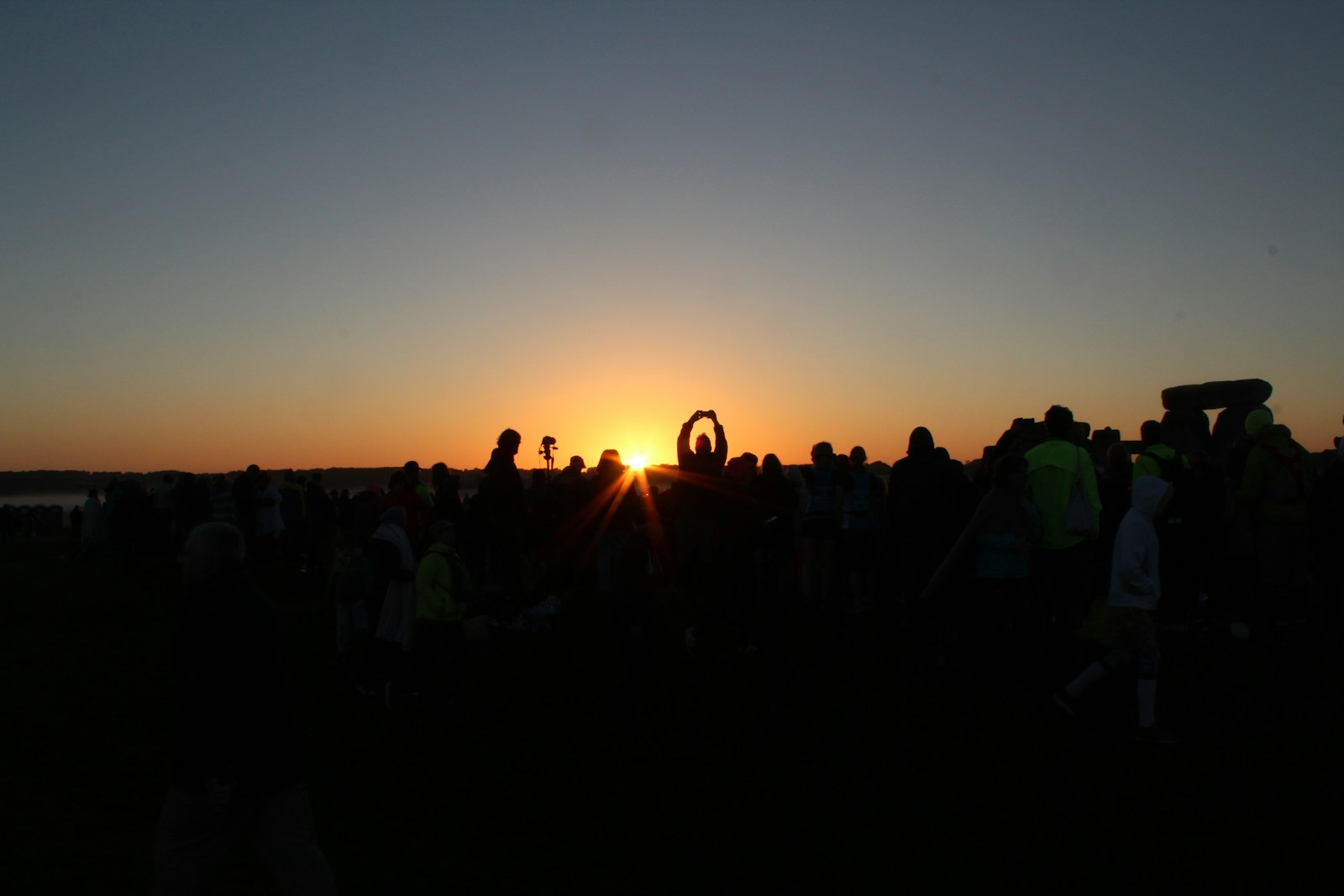
Around 5:30 in the morning on the winter solstice, December 21, a narrow shaft of sunlight enters the entrance of the Newgrange passage tomb in Ireland’s Boyne Valley, travels approximately twenty metres through a low stone passage, and illuminates the inner chamber for roughly seventeen minutes. The tomb was constructed around 3200 BCE — older than Stonehenge, older than the Egyptian pyramids — and the alignment is so precise that it survives a five-thousand-year drift in the position of the sun against the celestial backdrop. This is not lost knowledge or speculation. It is observable, every year, by visitors selected by lottery from the Irish state heritage agency.
This piece looks at what the evidence actually shows about ancient astronomical alignments at major prehistoric and historical sites, separating the well-documented from the speculative. The archaeology of astronomical alignment, called archaeoastronomy, has matured over the past forty years from a mostly amateur field into a peer-reviewed discipline with rigorous statistical methods.
What archaeoastronomy actually does
Archaeoastronomy attempts to determine whether and how ancient peoples incorporated celestial alignments into their architecture, monuments and rituals. The discipline has historically been split between two methodologies. The « green » tradition, dominant in the United Kingdom, applied rigorous statistical testing to large samples of monuments, asking whether observed alignments were more frequent than chance would predict. The « brown » tradition, dominant in Mesoamerican studies, focused on reading textual and iconographic evidence alongside specific monumental orientations.
Neither tradition supports the popular speculation that ancient peoples possessed astronomical knowledge equivalent to modern observatory science. What the evidence does support is that practical solar and lunar observation, often tied to agricultural calendars and ritual, was widespread, sometimes very precise, and regularly built into structures intended to last.
Stonehenge: the most-studied case
Stonehenge is the most studied archaeoastronomical site in the world. The summer solstice sunrise alignment along the principal axis, marked by the heel stone and the slaughter stone, has been documented since at least the eighteenth century. The winter solstice sunset alignment along the same axis, in the opposite direction, is now generally considered to have been the more important of the two for the original builders. Excavations led by Mike Parker Pearson in the late 2000s and 2010s identified pig bones at the nearby Durrington Walls feast site dating preferentially to midwinter, suggesting that winter rather than summer was the primary ceremonial occasion.
What is not supported by evidence is the more elaborate astronomical claims sometimes made for the site. The 1965 hypothesis by Gerald Hawkins, in his book Stonehenge Decoded, that the monument functioned as a sophisticated lunar eclipse predictor, has not held up to subsequent statistical re-analysis. Most recent scholarship treats Stonehenge as a ceremonial landscape with two clear solar alignments, embedded in a wider field of barrows and monuments, rather than as a single-purpose astronomical instrument.
Newgrange and the Boyne Valley
Newgrange is one of three large passage tombs in the Boyne Valley, alongside Knowth and Dowth. All three were constructed in the Middle Neolithic, between roughly 3300 and 2900 BCE. The Newgrange winter solstice alignment was rediscovered in 1967 by archaeologist Michael O’Kelly during the long restoration project. O’Kelly’s first observation, on December 21, 1969, has been confirmed every year since.
The alignment uses a small opening above the main entrance, called the roof box, which channels solstice sunrise light through the passage to the central chamber. The astronomical precision required for the design — accounting for sunrise position, atmospheric refraction and the rising terrain — is significant. The structure also incorporates a deliberate downward slope along the passage that compensates for the rising hill outside the entrance, allowing the light to reach the chamber even though the chamber sits below the elevation of the rising sun.
Knowth and Dowth, the two adjacent tombs, also contain probable astronomical alignments, though both are debated. Knowth’s eastern passage may align toward equinox sunrises, but the entrance is currently restricted by reconstruction work, making direct annual observation unreliable.
Chichén Itzá: the equinox effect
The Castillo (or Temple of Kukulcan) at Chichén Itzá in Mexico’s Yucatán is famous for an annual equinox phenomenon in which late-afternoon sunlight casts a sequence of triangular shadows along the staircase, producing an effect of a serpent descending the pyramid. The phenomenon occurs around March 20-22 and September 21-23 each year and now draws tens of thousands of visitors annually.
The phenomenon is real and visible. Its intentionality is partially supported by archaeological evidence: the staircase orientation, the relationship to the temple at the top, and the broader iconographic context of feathered serpent imagery in Maya cosmology all suggest the effect was at minimum noticed and probably designed for. However, the precise interpretation as a deliberate astronomical instrument is more contested. Susan Milbrath’s work on Maya astronomy, summarised in Star Gods of the Maya (1999), treats the Castillo as one element in a broader Maya cosmological architecture rather than as a discrete astronomical machine.
The Antikythera mechanism
The Antikythera mechanism is the most sophisticated piece of ancient astronomical technology yet recovered. Discovered in 1901 in a Roman-era shipwreck off the Greek island of Antikythera, the device is a complex bronze gear mechanism built around the second or first century BCE. After more than a century of research, including X-ray tomography work led by Mike Edmunds and Tony Freeth in the 2000s and 2010s, the mechanism is now understood to be a hand-cranked astronomical computer that calculated solar and lunar positions, predicted eclipses using the Saros cycle, and tracked the four-year cycle of athletic festivals including the Olympic Games.
The 2021 publication in Scientific Reports by Tony Freeth and colleagues at University College London proposed a complete reconstruction of the mechanism’s gear train, including the previously unresolved planetary display. The reconstruction, while still subject to some debate, suggests the mechanism contained 30 to 40 gears arranged in nested epicyclic systems of remarkable mathematical sophistication.
The Antikythera mechanism is genuinely anomalous in the ancient technological record. Nothing else of comparable complexity survives from the Hellenistic period. Whether the device represents a singular tradition or the lone surviving example of a now-lost class of instruments remains an open question.

Karahan Tepe and the deeper history
The recent excavation of Karahan Tepe, a sister site to Göbekli Tepe in southeastern Turkey, has extended the timeline of monumental ceremonial architecture earlier than previously documented. Karahan Tepe contains stone pillars dating to roughly 9500 to 8000 BCE — substantially older than any of the European megalithic sites — and several pillar arrangements appear to incorporate solar orientation features, though scholarly analysis is ongoing.
The Göbekli Tepe complex itself, excavated since 1995 by Klaus Schmidt and the German Archaeological Institute, has produced no widely accepted astronomical interpretation despite considerable popular speculation. The 2017 paper by Martin Sweatman and Dimitrios Tsikritsis in Mediterranean Archaeology and Archaeometry, which proposed that pillar 43 commemorated a comet impact at the start of the Younger Dryas, has been substantially criticised by working archaeoastronomers including Vance Tiede and Anthony Aveni. The site’s astronomical role, if any, remains genuinely unclear.
What is and is not supported by evidence
The reliable summary of archaeoastronomical evidence is something like this:
- Solar alignments at solstices and equinoxes are well-documented at numerous sites globally, often with verifiable precision.
- Lunar alignments, particularly at the major and minor lunar standstills, are documented at some sites (the Recumbent Stone Circles of Aberdeenshire, Scotland; certain Mesoamerican sites).
- Stellar alignments to specific bright stars (Sirius, the Pleiades, Orion’s belt) are claimed at many sites, but the evidence is more variable, partly because stellar positions shift through precession.
- Claims of alignment to specific planetary positions or rare celestial events are usually less well-supported and require careful statistical evaluation.
- Speculative claims about a coordinated global astronomical tradition predating known cultures are not supported by evidence.
Why the evidence matters
The honest version of ancient astronomical alignment is, in some ways, more interesting than the speculative version. It shows that practical celestial observation was widespread across many cultures, that significant architectural resources were invested in marking specific astronomical moments, and that the sophistication of observation sometimes — as with the Antikythera mechanism — exceeded what we would have expected from the surviving textual record alone.
It also shows that humans across a very wide range of climates and cultures attended to the same fundamental astronomical events: the solstices, the equinoxes, the lunar cycle, the rising of bright stars, the visibility of Venus and other planets. That convergence is itself an interesting observation about the cognitive and cultural significance of the sky, separate from any specific theory about who knew what.
Regional traditions worth knowing
Outside the well-known European and Mesoamerican sites, several regional astronomical traditions are now being documented in detail by working archaeologists. The Aboriginal Australian astronomical record, studied systematically by Duane Hamacher at the University of Melbourne and Ray Norris at Western Sydney University, shows continuous observational knowledge across at least 40,000 years, with documented oral traditions describing variable stars (including Betelgeuse), supernovae visible to the naked eye, and seasonal star calendars used for tracking food availability. The Wardaman people of the Northern Territory have an oral astronomical tradition that includes detailed knowledge of celestial events including the variability of long-period red giant stars, observable without instruments by careful naked-eye comparison.
In China, the astronomical record is exceptional in its textual continuity. Chinese astronomical observations span roughly three thousand years of continuous record-keeping, including some of the earliest documented sightings of supernovae (1054 CE Crab Nebula), comets (Halley’s Comet, observed at every passage since 240 BCE) and solar eclipses. The astronomical observatory at Gaocheng, dating to 1276 under the Yuan Dynasty, remains one of the largest pre-modern astronomical instruments in the world and produced calendar measurements accurate to within minutes per year.
In sub-Saharan Africa, the Nabta Playa stone circle in southern Egypt, dating to roughly 4500 BCE and predating Stonehenge by approximately a thousand years, contains a circle of stones with possible solstitial alignments. Excavations led by J. McKim Malville and Fred Wendorf in the 1990s and 2000s have proposed astronomical interpretations, though the desert location and the fragmentary state of the site mean that some interpretations remain debated. The site predates almost all the classic European megalithic sites by a thousand years, which has reshaped how the global timeline of monumental astronomy is understood.
Comparative analysis: precision and intentionality
One of the methodological challenges in archaeoastronomy is distinguishing intentional alignment from chance. Modern statistical methods, developed primarily in the late 1970s and 1980s by scholars including Clive Ruggles at the University of Leicester, treat alignment claims as hypotheses to be tested against the null hypothesis that the alignments could have occurred by chance given the overall orientation distribution of the site. The standard methodology is to identify all potential alignment targets (sun, moon, bright stars, planets) at a site, compute the angular positions in the relevant historical period accounting for precession, and ask whether the observed orientations cluster on those targets more than chance would predict.
Applied rigorously, the method has substantially narrowed the field of credible alignment claims. Many sites that earlier amateur archaeoastronomers proposed as astronomically aligned do not survive the statistical test once the full distribution of potential targets is included in the analysis. Stonehenge, Newgrange, the Castillo at Chichén Itzá, several Aboriginal Australian sites and a handful of others survive comfortably. Many other claims, including some of the more enthusiastic interpretations of European stone circles, do not.
The 2018 paper by Fabio Silva at the University of Wales Trinity Saint David, in the Journal for the History of Astronomy, applied a refined statistical methodology to portal tombs across the Atlantic Façade of Europe and found a statistically significant orientation toward the rising sun in the period of the year associated with the start of the lambing season. The result is interesting not for the orientation itself but for what it suggests about the integration of pastoral, agricultural and astronomical knowledge in Neolithic societies.
Misconceptions worth correcting
Several common misconceptions about ancient astronomy persist in popular media. The first is that ancient astronomical knowledge necessarily implies advanced technological civilisation. It does not. Naked-eye astronomy is capable of remarkable precision when sustained across generations of careful observers; pre-instrument astronomers in Mesopotamia, China, India and Mesoamerica achieved precision in solar and lunar timing that compares favourably with early instrument-based astronomy.
The second misconception is that ancient astronomical knowledge was uniform across cultures. It was not. The astronomical traditions of Mesopotamia, China, India, Mesoamerica, the European Neolithic and Aboriginal Australia developed largely independently, with significant differences in observational priorities, calendrical structure and interpretive framework. The convergent attention to solstices and equinoxes reflects the universal observability of those events, not a shared origin.
The third misconception is that the Antikythera mechanism implies a hidden tradition of advanced ancient technology. The mechanism is genuinely sophisticated, but it sits within a documented Hellenistic tradition of geared astronomical models described in Cicero, Pliny and other Roman-era texts. The mechanism may be the only physical survivor of a small but historically attested class of devices, rather than evidence of a wholly unrecorded technological civilisation.
How to evaluate astronomical-alignment claims
For readers encountering archaeoastronomical claims in popular books or documentaries, a few practical evaluation criteria help separate well-supported claims from speculation.
- Is the alignment specifically dated? Astronomical positions shift over millennia due to precession of the equinoxes. A claimed alignment must specify the period in which it was supposedly used, and the alignment must hold for that period.
- Are alternative targets considered? A monument oriented to « the sun » is trivially aligned to one of dozens of solar positions across the year. A specific alignment to one defined event (summer solstice sunrise, for example) is more meaningful.
- Has the claim been peer-reviewed? Archaeoastronomy now has dedicated journals (the Journal for the History of Astronomy, Archaeoastronomy) and a standard methodology. Claims published outside this peer-reviewed infrastructure deserve more scepticism.
- Does the claim survive after excavation evidence? Several alignment claims have been overturned by excavations showing that the proposed astronomical viewpoint was obstructed by structures or earthworks contemporary with the original construction.
- Is the cultural context plausible? An astronomical alignment tied to a specific celestial event should be supported by independent evidence (textual, iconographic, ethnographic) that the relevant culture cared about that event.
Further reading
For an overview of the field, see the Wikipedia entry on archaeoastronomy and Anthony Aveni’s Skywatchers of Ancient Mexico (1980, revised 2001), still the standard work on the Mesoamerican tradition. The British Museum holds substantial Antikythera mechanism research material and collaborated on the most recent reconstructions. The NASA Goddard Space Flight Center maintains accessible educational resources on solar and lunar position calculation that allow amateur readers to verify alignment claims for any historical date. Our archive on ancient mysteries is filed at mystères spatiaux, with broader unsolved-history coverage at mystères inexpliqués, and a separate thread on ancient civilisations tracking new excavations and dating revisions.
This article reflects publicly available archaeological research as of early 2026; specific interpretations remain contested in scholarly literature, and readers should consult primary archaeological reports for the most current evidence.
Votre analyse